 Mobiles are airy, hanging sculptures that move with the wind. Alexander Calder (1898-1976), an American sculptor, invented the mobile in the early 20th century. His mobiles eventually became famous worldwide.
 CAN AND CAN OPENER A metal can (or canister) for preserving food was invented in 1810 by a Peter Durand, of London, England. Metal cans (also called tins) could preserve food for a long period of time. To open a can, a person had to use a hammer and chisel; the can opener wasn't invented for another 50 years. A metal can (or canister) for preserving food was invented in 1810 by a Peter Durand, of London, England. Metal cans (also called tins) could preserve food for a long period of time. To open a can, a person had to use a hammer and chisel; the can opener wasn't invented for another 50 years. The can opener was invented in 1858 by Ezra Warner of Waterbury, Connecticut, USA. Warner's device used a lever and chisel. Until then, cans were opened using a hammer and chisel; the can opener was invented 50 years after the metal can was invented. The can opener was improved in 1870 by William Lyman of West Meridian, Connecticut, USA. Lyman's device used a rotating wheel and a sharp edge. His can opener only fit one size of can, and first had to pierce the center of the can. The modern-day type of can opener (using a serrated wheel) was invented in 1925. |
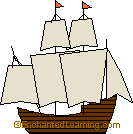 The caravel (also spelled carvel) is a light sailing ship that that was developed by the Portuguese in the late 1400's, and was used for the next 300 years. The Portuguese developed this ship to help them explore the African coast.
  People have been drinking naturally-carbonate d water (water with carbon dioxide bubbles) since pre-historic times. The English chemist Joseph Priestley experimented with putting gases in liquids in 1767, producing the first artificially- produced carbonated water.
 | CARLSON, CHESTER F. Chester Floyd Carlson (1906-1968) invented xerography (which means "dry writing" in Greek) in 1938. Xerography makes paper copies without using ink (hence its name). In this process, static electricity charges a lighted plate; a plastic powder (called toner) is applied to the areas of the page to remain white. Chester F. Carlson was born in Seattle, Washington, USA. As a teenager, Carlson supported his invalid parents by publishing a chemical journal. After attending Cal Tech in physics, Carlson worked at an electronics firm. Carlson later experimented at home to find an efficient way of copying pages. He succeeded in 1938, and marketed his revolutionary device to about 20 companies before he could interest any. The Haloid Company (later called the Xerox Corporation) marketed it, and photocopying eventually became common and inexpensive. |
CARVER, GEORGE WASHINGTON 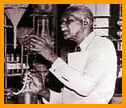 George Washington Carver (1865?-1943) was an American scientist, educator, humanitarian, and former slave. Carver developed hundreds of products from peanuts, sweet potatoes, pecans, and soybeans; his discoveries greatly improved the agricultural output and the health of Southern farmers. Before this, the only main crop in the South was cotton. The products that Carver invented included a rubber substitute, adhesives, foodstuffs, dyes, pigments, and many other products. George Washington Carver (1865?-1943) was an American scientist, educator, humanitarian, and former slave. Carver developed hundreds of products from peanuts, sweet potatoes, pecans, and soybeans; his discoveries greatly improved the agricultural output and the health of Southern farmers. Before this, the only main crop in the South was cotton. The products that Carver invented included a rubber substitute, adhesives, foodstuffs, dyes, pigments, and many other products. |
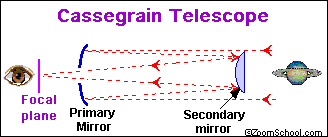 CASSEGRAIN TELESCOPE CASSEGRAIN TELESCOPEA Cassegrain telescope is a wide-angle reflecting telescope with a concave mirror that receives light and focuses an image. A second mirror reflects the light through a gap in the primary mirror, allowing the eyepiece or camera to be mounted at the back end of the tube. The Cassegrain reflecting telescope was developed in 1672 by the French sculptor Sieur Guillaume Cassegrain. A correcting plate (a lens) was added in 1930 by the Estonian astronomer and lens-maker Bernard Schmidt (1879-1935), creating the Schmidt-Cassegrain telescope which minimized the spherical aberration of the Cassegrain telescope. |
 CAXTON, WILLIAM
| CELLULAR PHONE The first automatic analog cellular phone was made in the 1960's. Commercial models were introduced in Japan by NTT on December 3, 1979. They were introduced in Scandinavia in 1981, in Chicago, USA, on October 13, 1983 (by Motorola), and in Europe in the late 1980's. Early mobile FM (frequency modulation radio was invented by Edwin H. Armstrong in 1935) radio telephones had been in use in the USA since 1946, but since the number of radio frequencies are very limited in any area, the number of phone calls was also very limited. Only a dozen or two calls could be made at the same time in an area. To solve this problem, there could be many small areas (called cells) which share the same frequencies. But when users moved from one area to another while calling, the call would have to be switched over automatically without losing the call. In this system, a small number of radio frequencies could accommodate a huge number of calls. This cellular phone concept was devised by a team of researchers at Bell Labs in 1947, but there were no computers available to do the switching. As small inexpensive computers were developed, cell phones could be produced. Motorola holds the US patents for the cell phone. Henry Taylor Sampson and George H. Miley hold a 1968 patent (US patent #3,591,860) on a "gamma electric cell," which is not a component of cellular phones. |
  CELSIUS, ANDERS CELSIUS, ANDERSAnders Celsius (1701-1744) was a Swedish professor of astronomy who devised the Celsius thermometer. He also ventured to the far north of Sweden with an expedition in order to measure the length of a degree along a meridian, close to the pole, later comparing it with similar measurements made in the Southern Hemisphere. This confirmed that that the shape of the earth is an ellipsoid which is flattened at the poles. He also cataloged 300 stars. With his assistant Olof Hiorter, Celsius discovered the magnetic basis for auroras. |
 CHOCOLATE CHIPS
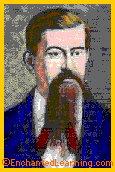 Dr. John Stith Pemberton (1830-1888) was an American pharmacist, soldier, and inventor. He invented Coca-Cola on May 8th, 1886 in Atlanta, Georgia, USA. He had invented many syrups, medicines, and elixirs before, including a very popular drink called French Wine of Coca, which contained French Bordeaux wine, coca leaves, and caffeine (from the kola nut).
  COMPASS
| CONTACT LENSES Contact lenses are tiny removable lenses that are worn in contact with the eye (they rest directly on the cornea of the eye). Like glasses, they improve the wearer's vision. This type of lens was envisioned (but not actually made) by Leonardo da Vinci (around 1508) and later by René Descartes (around 1636-1637). Contact lenses were invented and made in 1887 by the German physiologist Adolf Eugen Fick (1829-1901). He first fitted animals with the lenses, and later made them for people. These lenses were made from heavy brown glass and were 18-21mm in diameter. The lenses were improved by August Muller in 1889; he made lenses that corrected myopia (nearsightedness) . Plastic contact lenses were first made by the California optician Kevin Tuohy in 1948. Soft contact lenses (hydrophilic lenses) and gas-permeable lenses (which let oxygen pass through the lens and to the cornea) were invented in the 1970s. |
 The "lead" pencil (which contains no lead) was invented in 1564 when a huge graphite (black carbon) mine was discovered in England. The pure graphite was sawn into sheets and then cut into square rods. The graphite rods were inserted into hand-carved wooden holders, forming pencils. They were called lead pencils by mistake - at the time, graphite was called black lead or "plumbago," from the Greek word for lead (it looked and acted like lead, and it was not known at the time that graphite consisted of carbon and not lead).
 | COTTON GIN The cotton gin is a machine that cleans cotton, removing its many seeds. This device revolutionized the cotton industry. Previously, this tedious job had been done by hand, using two combs. Eli Whitney (1765-1825) was an American inventor and engineer who invented the cotton gin; he patented the cotton gin on March 14, 1794. The cotton gin made much of the southern United States very rich, but cotton plantation owners rarely paid Whitney for the use of his invention, and Whitney went out of business. |
 Jacques-Yves Cousteau (1910-1997) was a French undersea explorer, environmentalist, and innovator. In 1943, Cousteau and the French engineer Emile Gagnan invented the aqualung, a breathing apparatus that supplied oxygen to divers and allowed them to stay underwater for several hours. Cousteau traveled the world's oceans in his research vessel "Calypso," beginning in 1948. (Calypso was a converted 400-ton World War 2 minesweeper; it sank in 1996, after being hit by a barge in Singapore harbor). Cousteau's popular TV series, films and many books [including "The Living Sea" (1963), and "World Without Sun" (1965)] exposed the public to the wonders of the sea.
 CRAYONS
 The first upright piano was made around 1780 by Johann Schmidt of Salzburg, Austria. Thomas Loud of London developed an upright piano whose strings ran diagonally (in 1802), saving even more space.
